
What Trauma Does to the Body: Where the Past Lives in You
You can close a chapter of your life and still find your body refusing to read the ending: the shoulders that never drop, the sleep that breaks at a sound, the stomach that clenches in a perfectly safe room. This is not weakness or imagination. Trauma is a physiological event as much as a psychological one — the body learns danger, and it keeps that lesson in muscle tension, hormone levels, and an alarm that never fully powers down. Understanding where the past lives in your body is the beginning of teaching it that the danger is over.
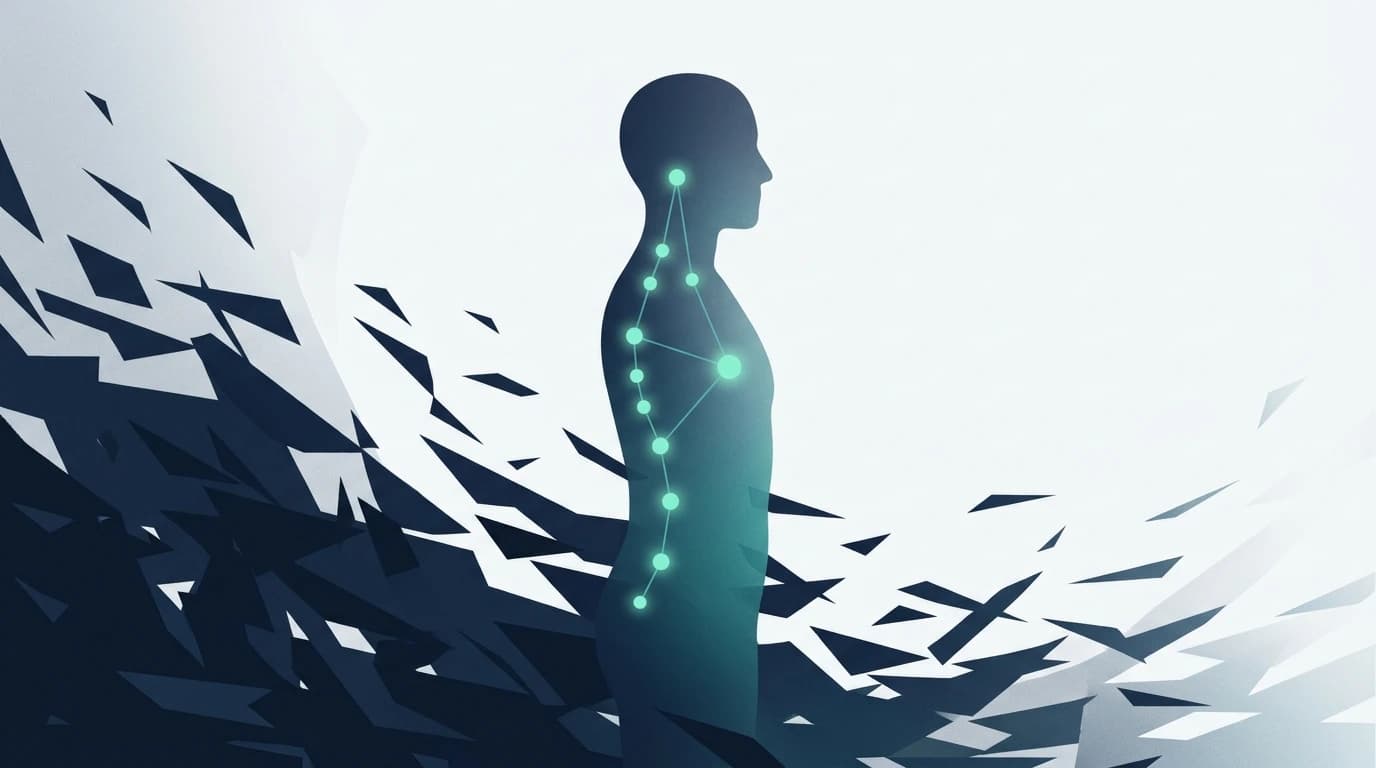
The Alarm, the Archive, and the Brake
Three systems carry most of trauma's imprint. The amygdala — the brain's smoke detector — becomes hypervigilant after overwhelming experience, firing alarms at harmless cues that vaguely resemble the original threat: a tone of voice, a smell, footsteps behind you. The hippocampus, which time-stamps memories as finished, shrinks its output under chronic stress, which is why traumatic memories feel present-tense instead of past-tense. And the HPA axis — the hormonal cascade behind cortisol and adrenaline — recalibrates to a higher idle, leaving you exhausted yet unable to rest. None of this is a defect; each change was a survival adaptation that outstayed the danger.
How the Body Keeps the Score
Bessel van der Kolk's famous phrase is a clinical description, not poetry. Unprocessed trauma often surfaces as the body's ledger: chronic muscle tension in the neck, jaw, and pelvis; unexplained gut problems, because the gut is richly wired to the alarm system; migraines, shallow breathing, a startle response that fires at nothing. People frequently spend years chasing these symptoms organ by organ before anyone names the pattern. When doctors cannot find a cause, that is not proof the suffering is imaginary — it is often proof the suffering is being stored somewhere no scan looks: in a nervous system still running yesterday's emergency plan.
The Body Learns Danger — and It Can Unlearn It
The hopeful news is symmetry: the same neuroplasticity that encoded threat can encode safety, provided you speak the body's language — repetition, sensation, and rhythm rather than argument. Slow exhaled breathing signals the alarm to stand down. Grounding through the five senses supplies present-tense evidence that contradicts past-tense fear. Gentle movement — walking, stretching, shaking out the arms — discharges the mobilized energy that freeze responses trapped. None of these practices erases what happened; they teach the body a second, competing lesson, and with daily repetition the second lesson starts to win. This is why body-based practices sit at the heart of every serious trauma-recovery model.
Reading Your Body's Ledger: A One-Week Practice
For one week, do a two-minute body scan at the same hour each evening: from head to feet, notice where you are holding — jaw, shoulders, stomach, hands — and simply name it without fixing it. Then apply one body-level intervention daily: ten minutes of paced breathing, a slow walk without your phone, or a hot shower with attention on the sensation of warmth. The goal is not immediate calm; it is building the basic trust that your body's states are readable and changeable. That trust is stage one of trauma recovery — and every tool that follows depends on it.
Scientific References
The ideas in this article are grounded in peer-reviewed research and trusted academic sources:
- 1van der Kolk, B. A. (2014). The Body Keeps the Score: Brain, Mind, and Body in the Healing of Trauma. Viking / Penguin Random House Link
- 2Bremner, J. D. (2006). Traumatic stress: Effects on the brain. Dialogues in Clinical Neuroscience — PMC Link
- 3Yehuda, R., et al. (2015). Post-traumatic stress disorder. Nature Reviews Disease Primers Link
Ready to Start Your Transformation?
Every insight you gain is a stepping stone. The real change begins when you take the first step with the right tools.