
Grounding for Flashbacks: Evidence That You Are Here Now
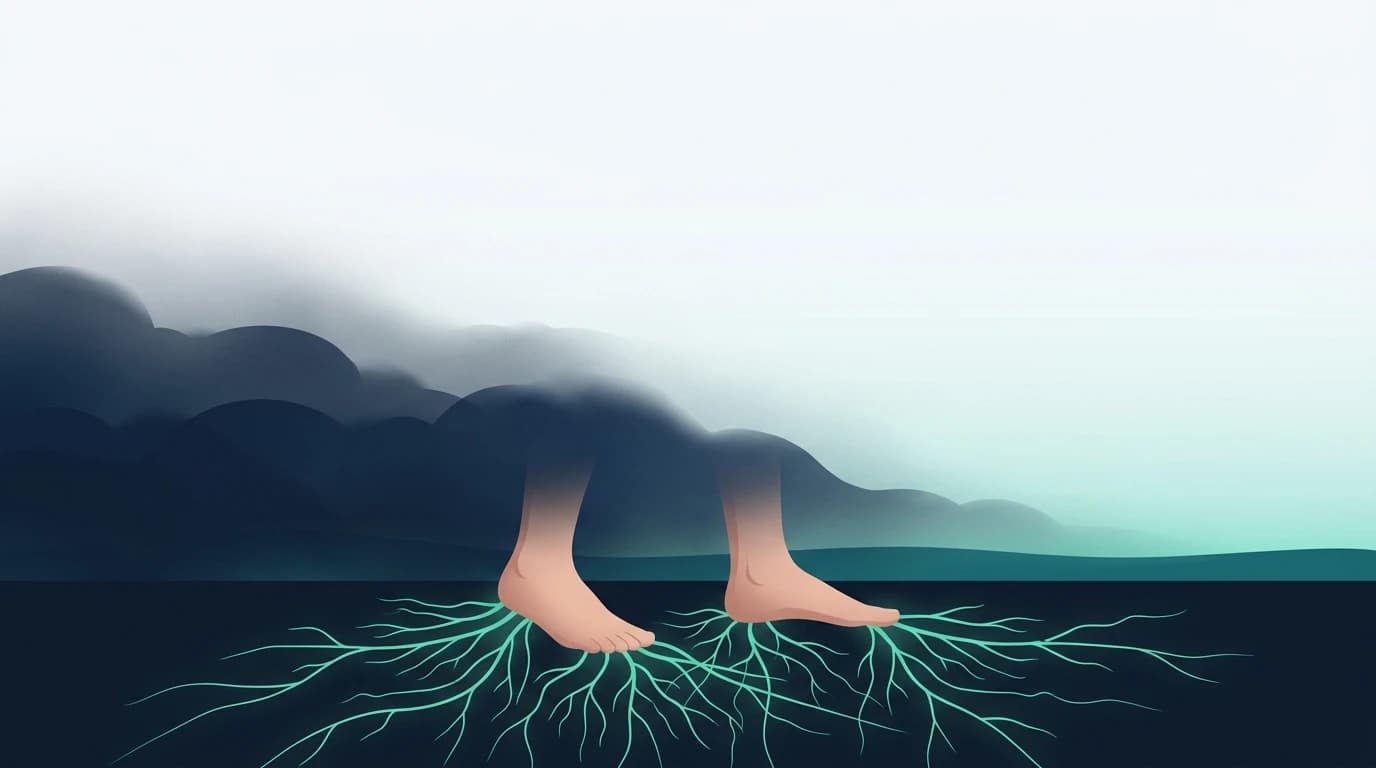
A flashback is not remembering — it is reliving. The past arrives with the senses of the present: the smell, the sound, the body state, without any felt boundary saying it happened then and not now. That is why being told you are safe rarely helps; your nervous system does not accept arguments, it accepts evidence. Grounding is the practice of handing your senses that evidence, sixty seconds at a time, until your body believes what the calendar already knows: you are here, and it is now.
Why Grounding Works
During a flashback, the brain's smoke detector has hijacked attention and the time-stamping system has failed, so the experience runs without a past label. Sensory attention competes directly with that process: you cannot fully attend to the texture of a blanket and the sensations of the past scene at the same time. Grounding exploits this bottleneck deliberately. By loading all five channels of input with present-moment data, you force the nervous system to choose the channel that has a date on it — today. Over repetitions, the brain also relearns the association: intensity does not automatically mean danger, and sensation in the present can be tolerated.
The 5-4-3-2-1 Technique, Slowly
Work through the five senses in order, naming items out loud when possible: five things you can see (the exact color of the wall, a shadow's edge), four things you can physically feel (fabric, chair pressure, the temperature of your hands), three things you can hear (near, far, and your own breath), two things you can smell (or two smells you like), and one thing you can taste (or one slow sip of water). The power is in the detail: one specific thing per channel beats ten vague ones. If you lose count — you will, at first — that is not failure; starting over is the practice.
A Grounding Kit for the Days It Feels Impossible
Build your kit before the storm, not during it. Strong sensory anchors work best: an ice cube held in the hand, a citrus peel to smell, peppermint gum, a stone with a distinct texture kept in a pocket. Add orientation phrases you can repeat without thinking — my name is..., I am in..., today is... — because speech uses different brain circuitry than the flashback does. Feet on the floor, pressing down, is a primitive but powerful anchor; so is temperature, which is why cold water on the face or wrists resets so effectively. Write your five anchors on a card. In distress, you will not remember the clever plan — you will only do what the card says.
After the Wave Passes
Once you are back in the present, do not rush away from yourself. Drink water, wrap in a blanket, and let your heart rate settle — a flashback floods the body with stress chemistry, and the aftercare matters as much as the exit. Then, later and gently, note what preceded the episode: time, place, tiredness level, any cue. Patterns there are not accusations; they are scheduling information, telling you when extra support or an earlier bedtime would help. Flashbacks tend to lose both frequency and force as the nervous system accumulates proof of safety — and grounding is how you collect that proof, sixty seconds at a time.
Scientific References
The ideas in this article are grounded in peer-reviewed research and trusted academic sources:
- 1U.S. Department of Veterans Affairs — National Center for PTSD: Grounding techniques. PTSD: National Center for PTSD (VA) Link
- 2van der Kolk, B. A. (2014). The Body Keeps the Score: Brain, Mind, and Body in the Healing of Trauma. Viking / Penguin Random House Link
- 3Briere, J., & Scott, C. (2015). Principles of Trauma Therapy: A Guide to Symptoms, Evaluation, and Treatment (2nd ed.). SAGE Publications Link
Ready to Start Your Transformation?
Every insight you gain is a stepping stone. The real change begins when you take the first step with the right tools.