
Understanding the Compulsion Cycle: The Moment It Breaks
A compulsive behavior never starts at the moment you give in. It starts minutes — sometimes hours — earlier, at a point so ordinary you barely notice it: a bored evening, a stressful message, the phone lighting up in an empty room. By the time you feel the urge as an urge, most of the loop has already run. Understanding the compulsion cycle stage by stage is the first recovery skill, because you cannot break a loop you cannot see.
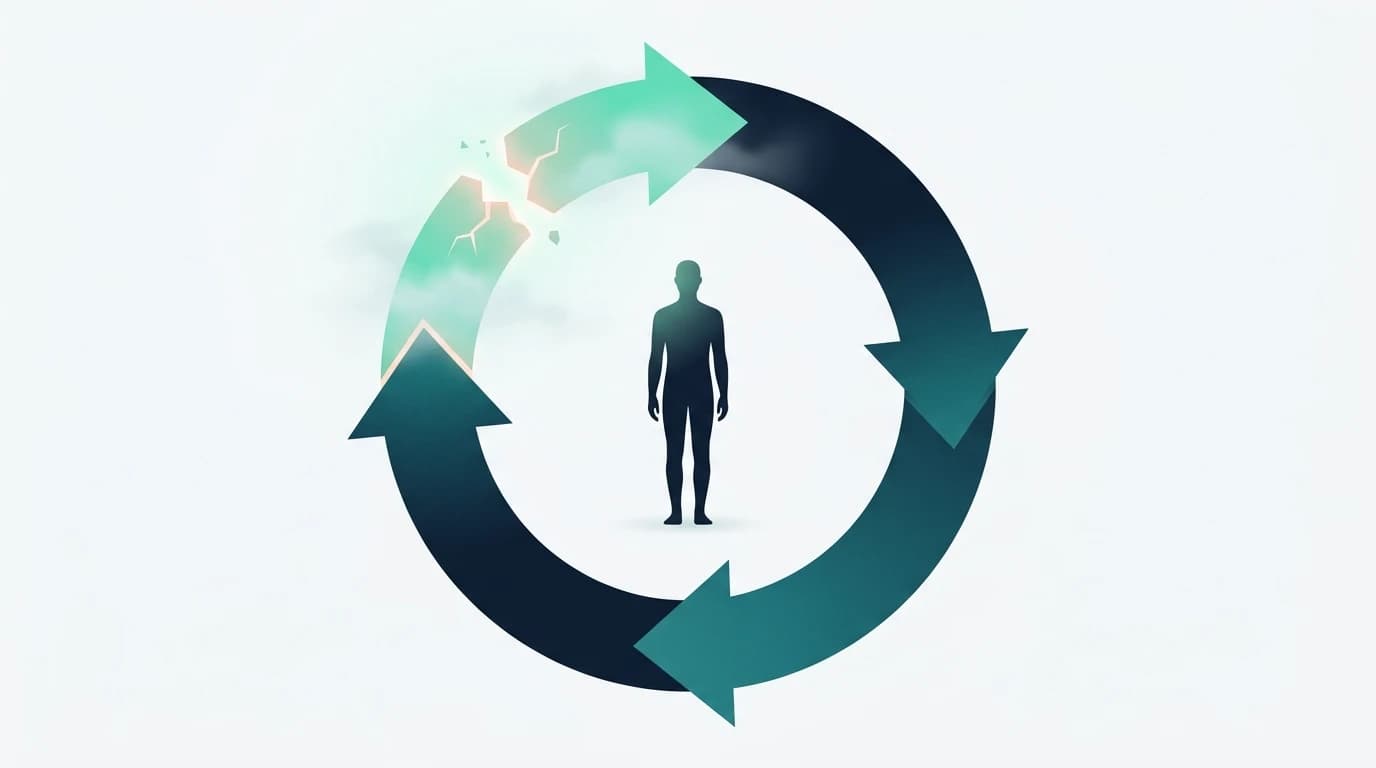
The Five Stages of the Loop
Clinical models of addictive behavior — from Marlatt's relapse-prevention work to modern neuroscience of habit — describe the same architecture. First comes the trigger: an internal state (stress, boredom, loneliness, fatigue) or an external cue (a device, a time of day, a private space). The trigger does not ask permission; it simply starts the search. Second comes the ritual: the small, rehearsed sequence that leads toward the behavior — closing a door, opening an incognito tab, telling yourself this is the last time. The ritual is where the brain anticipates the reward and dopamine spikes before anything has happened.
Third is the behavior itself, experienced on autopilot rather than as a decision. Fourth comes the relief — real, fast, and short-lived, which is exactly what teaches the brain to repeat the loop. Fifth arrives the hangover: the drop, the guilt, the promises. Crucially, the shame of stage five becomes tomorrow's trigger, feeding the very loop it condemns. The cycle is not a moral failure; it is a learned circuit that fires faster than conscious thought, which is why good people keep doing what they sincerely intend to stop.
Why Willpower Waits Too Late
Most people aim their willpower at stage three — the behavior itself — when the internal debate is already over. By then, dopamine has narrowed your attention to one goal, the prefrontal brake is weakened by stress, and the urge feels like a need. Research on habit and relapse consistently shows that intervention succeeds earlier in the chain: a trigger noticed at stage one, or a ritual interrupted at stage two, requires a fraction of the strength that resisting at stage three requires. This is not a character insight — it is a timing insight.
The Breaking Point: The Space Between Craving and Ritual
Every loop has one weak link, and for compulsive behaviors it is the gap between feeling the pull and starting the ritual. In that gap — often less than two minutes wide — you are still choosing. The skill is to make that gap visible and longer. Name the trigger out loud or on paper: I am bored, I am anxious, I am alone. Naming shifts activity from the automatic circuitry of the striatum toward the prefrontal cortex, the part of you that can deliberate. Then insert one physical disruptor: stand up, change rooms, put the phone in another space, splash water on your face. You are not trying to win an argument with the urge; you are buying your deliberating brain enough time to come back online.
Map Your Own Cycle — Then Attack One Link
For the next seven days, keep a two-line log: the moment you noticed an urge (time, place, state) and what you did next. Patterns will surface quickly — most people find three recurring triggers and one fixed ritual. Then choose a single link to attack this week: remove one trigger if you can (device out of the bedroom, content blocker on), or interrupt one ritual (no screens in the bathroom, a walk at your highest-risk hour). Do not try to fight the whole loop at once. Recovery is won link by link, and every link you weaken makes the next one easier to see — and easier to break.
Scientific References
The ideas in this article are grounded in peer-reviewed research and trusted academic sources:
- 1Marlatt, G. A., & Gordon, J. R. (1985). Relapse Prevention: Maintenance Strategies in the Treatment of Addictive Behaviors. Guilford Press Link
- 2Volkow, N. D., Koob, G. F., & McLellan, A. T. (2016). Neurobiologic advances from the brain disease model of addiction. New England Journal of Medicine Link
- 3Graybiel, A. M. (2008). Habits, rituals, and the evaluative brain. Annual Review of Neuroscience Link
Ready to Start Your Transformation?
Every insight you gain is a stepping stone. The real change begins when you take the first step with the right tools.